Fossil was released on October 10th, 1999 as the third expansion to the Pokémon TCG, following Base Set and Jungle. Its 62 cards focus on fossil-revived and prehistoric Pokémon such as Aerodactyl, Kabutops, and Omastar, alongside the Legendary Birds Articuno, Zapdos, and Moltres, and fan favorites Dragonite and Gengar.
For collectors, Fossil completes the original WotC trio (Base, Jungle, Fossil) that defines vintage Pokémon. It exists in 1st Edition and Unlimited printings, and its holos — especially Dragonite and Gengar — remain some of the most nostalgic cards in the hobby.
This guide covers how to identify a Fossil card, the chase holos, the print variants and errors, and how to determine what your cards are worth today.
How to identify a Fossil card
Fossil cards carry a distinctive set symbol shaped like a fossilized ammonite/shell near the card name or artwork. This immediately separates Fossil from Base Set (no symbol) and Jungle (flower/tree symbol).
- Look for the Fossil ammonite/shell set symbol.
- 1st Edition cards have the black "Edition 1" stamp on the left of the artwork.
- Card numbers read "x/62".
- Some early cards were printed without the set symbol — a known Fossil error, similar to Jungle.
Fossil chase cards
Fossil has 15 holographic rares (cards 1–15), each also printed as a non-holo rare. The holos below carry most of the value, especially in 1st Edition and high grade.
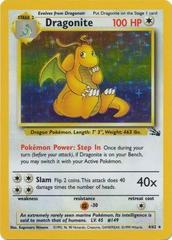
Dragonite
4/62
The signature Fossil chase card; iconic artwork.
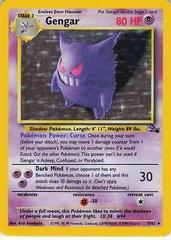
Gengar
5/62
Beloved ghost holo with enduring demand.
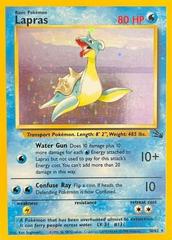
Lapras
10/62
Popular water holo, strong in high grade.
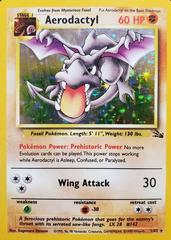
Aerodactyl
1/62
The card that opens the set; fossil theme centerpiece.
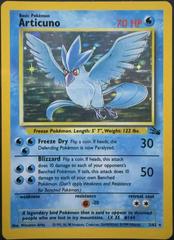
Articuno
2/62
Legendary Bird holo.
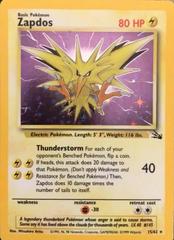
Zapdos
15/62
Legendary Bird holo.
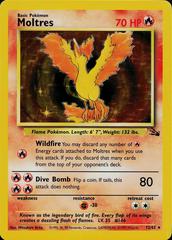
Moltres
12/62
Legendary Bird holo.
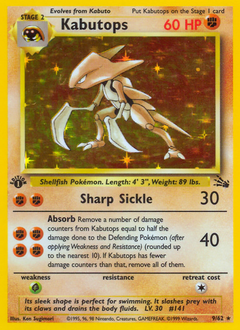
Kabutops
9/62
Fan-favorite fossil evolution holo.
Card images are provided for identification via our pricing partner. Pokémon and card artwork are trademarks of their respective owners; Card Buyers is not affiliated with or endorsed by Nintendo, The Pokémon Company, or Wizards of the Coast.
Fossil print variants
Like Jungle, Fossil comes in two main editions plus early no-symbol prints.
1st Edition
Black "Edition 1" stamp to the left of the artwork. Scarcer than Unlimited and worth a significant premium, especially for holos.
Unlimited
No edition stamp — the standard, more common printing.
No Set Symbol error
As with Jungle, some early Fossil cards were printed missing the set symbol, creating collectible error variants.
Errors & misprints
Fossil has a handful of well-known quirks collectors look for.
No Set Symbol
Early Fossil prints omitted the set symbol on some cards, mirroring the Jungle error and prized by collectors.
Zapdos (15/62) missing evolution box
On both 1st Edition and Unlimited holo Zapdos, the evolution box in the top-left was cut out of the holofoil in the first printing before being corrected — a widely tracked Fossil error.
Krabby (51/62) incomplete set symbol
Early Krabby cards show a partially incomplete Fossil set symbol, later corrected in subsequent prints.
Haunter (6/62) artwork stain
A printing stain in the lower-right corner of the Haunter artwork appears on early copies and was cleaned up in the corrected print.
Fossil theme decks
Fossil shipped with two preconstructed 60-card theme decks. Sealed copies are collectible in their own right, and the deck exclusives help date loose cards.
| Deck | Types | Signature Pokémon |
|---|---|---|
| BodyGuard | Grass / Fighting | Kabutops, Golem, Muk |
| LockDown | Fire / Water | Magmar, Articuno, Lapras |
The last Starlight-holo set
Fossil was the final WotC expansion to use the original "Starlight" holofoil pattern — the fractured, cracked-ice foil that defines Base Set, Jungle, and Fossil holos. From Base Set 2 onward, Wizards switched to the "Cosmos" holofoil (a starry, speckled pattern). That makes Fossil a natural bookend to the original-era holo look, which is part of why collectors prize a matched Base/Jungle/Fossil holo run.
A small number of Cosmos-holo Fossil cards do exist, printed later, but the vast majority of genuine Fossil holos you will encounter carry the Starlight pattern. If a "Fossil" holo shows Cosmos foil, verify the set symbol and copyright line before assuming it is original.
Grading and condition notes for Fossil
Like all WotC holos, Fossil cards are prone to edge whitening, holo scratches, and print lines. The dark backgrounds on cards like Gengar and Haunter make edge wear and surface scratches especially visible, so grade is a major value driver.
When self-assessing, check the four corners under angled light, look across the holo for hairline scratches, and inspect the black border for whitening. 1st Edition copies with strong centering and clean surfaces are the ones that reach the top of the market in PSA/BGS 9 and 10.
Full Fossil holo rare checklist
All 15 Fossil holographic rares (cards 1–15/62). Each also exists as a non-holo rare (cards 16–30). Use this to check off a complete holo run.
| # | Card | Type |
|---|---|---|
| 1/62 | Aerodactyl | Fighting |
| 2/62 | Articuno | Water |
| 3/62 | Ditto | Colorless |
| 4/62 | Dragonite | Colorless |
| 5/62 | Gengar | Psychic |
| 6/62 | Haunter | Psychic |
| 7/62 | Hitmonlee | Fighting |
| 8/62 | Hypno | Psychic |
| 9/62 | Kabutops | Fighting |
| 10/62 | Lapras | Water |
| 11/62 | Magneton | Lightning |
| 12/62 | Moltres | Fire |
| 13/62 | Muk | Grass |
| 14/62 | Raichu | Lightning |
| 15/62 | Zapdos | Lightning |
What is Fossil worth?
As with Jungle, Fossil value comes down to edition, holo status, and grade. A 1st Edition holo Dragonite or Gengar in PSA/BGS 9–10 is the top of the market, while Unlimited commons and non-holo rares are modest individually.
The Legendary Birds (Articuno, Zapdos, Moltres) and the fossil evolutions (Kabutops, Aerodactyl) hold steady collector interest. A complete or near-complete Fossil set — particularly 1st Edition — is best valued as a whole.
Search any Fossil card for an instant offer, or send the full set in for a free appraisal.
Related set guides
1999
Jungle Set Guide
Jungle was the second Pokémon expansion ever released and the first to follow Base Set. It is famous for its Eeveelutions, Snorlax, Scyther, and the sought-after no-set-symbol error. Here is everything a collector needs to identify, grade, and value Jungle cards.
2000
Base Set 2 Set Guide
Base Set 2 is a 130-card reprint that combined the best of Base Set and Jungle into one release. It has no 1st Edition and is often confused with the original Base Set. Here is how to tell them apart and what Base Set 2 cards are worth.
2000
Team Rocket Set Guide
Team Rocket introduced "Dark" Pokémon and the first secret rare in TCG history — Dark Raichu #83. It gave us the fan-favorite Dark Charizard. Here is how to identify, grade, and value Team Rocket cards.
Frequently asked questions
How many cards are in the Pokémon Fossil set?
The Fossil set has 62 cards, including 15 holographic rares (cards 1–15). Each holo also exists as a non-holo rare, and the set was printed in both 1st Edition and Unlimited runs.
What is the most valuable Fossil card?
In high grade, the 1st Edition holo Dragonite and Gengar are the standout chase cards, followed by Lapras, the Legendary Birds, and the fossil evolutions. No-set-symbol variants add a premium.
How do I tell Fossil apart from Base Set and Jungle?
Fossil cards have an ammonite/shell set symbol. Base Set cards have no symbol at all, and Jungle cards use a flower/tree symbol. Also check the card number: Fossil reads "x/62."
Does Fossil have a 1st Edition?
Yes. 1st Edition Fossil cards carry the black "Edition 1" stamp to the left of the artwork and are scarcer and more valuable than the Unlimited printing.
Which Legendary Birds are in Fossil?
All three original Legendary Birds appear as Fossil holos: Articuno (2/62), Moltres (12/62), and Zapdos (15/62). Each also has a non-holo rare version, and collectors often chase the three together as a set.
Why do some Fossil holos look different from Base Set holos?
Fossil was the last set to use the original "Starlight" holofoil pattern seen in Base Set and Jungle. A handful of later Cosmos-holofoil Fossil cards exist, but genuine Fossil holos almost always show the Starlight pattern.
What is the Zapdos evolution box error?
On the first printing of holo Zapdos (15/62), the evolution box in the top-left corner was cut out of the holofoil. It was corrected in later prints, and collectors track the earlier version as a notable Fossil error.