Base Set was the first Pokémon expansion ever printed for the trading card game, released in Japan in October 1996 and worldwide on January 9th, 1999. Produced under contract by Media Factory (Japan) and Wizards of the Coast (WotC) for the rest of the world, it is the cornerstone of the entire "WotC era" that vintage collectors chase today.
It is also the most variant-heavy set Pokémon ever released, which makes it endlessly interesting — and easy to get wrong. Below we break it all down clearly, then help you figure out what your specific cards are worth.
How to identify a Base Set card
A Base Set card is recognized by two things: the absence of a set symbol and a set number printed as "/102" in the bottom-right corner of the card.
Look for "/102"
Every Base Set card ends in /102. If you see a set icon next to the number, it is from a later set — not Base Set.
Watch the Jungle trap
A printing error left some English Jungle cards without a set symbol too — but those read "/64," so the number gives them away. Japanese Base Set cards have no set number at all; the missing symbol is the only tell.
The 16 holographic rares
These 16 Holographic Foil rares (1/102–16/102) are the heart of the set and where almost all the value sits. The artwork below is pulled live from our pricing catalog, so you can match your card to the real thing.
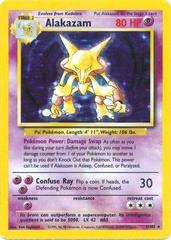
Alakazam
1/102
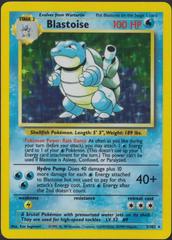
Blastoise
2/102
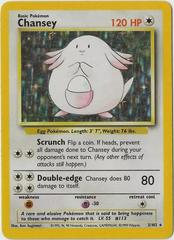
Chansey
3/102
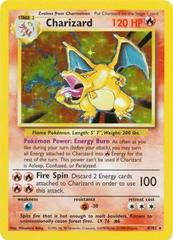
Charizard
4/102
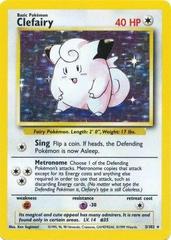
Clefairy
5/102
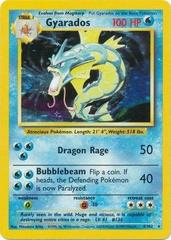
Gyarados
6/102
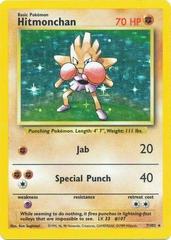
Hitmonchan
7/102
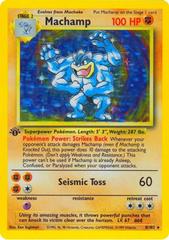
Machamp
8/102
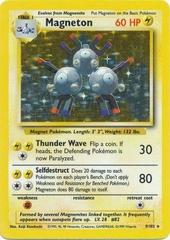
Magneton
9/102
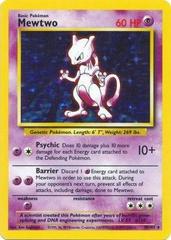
Mewtwo
10/102
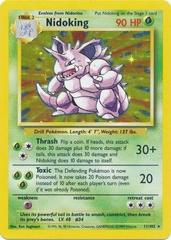
Nidoking
11/102
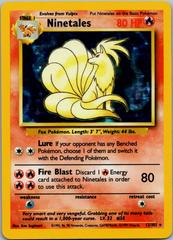
Ninetales
12/102
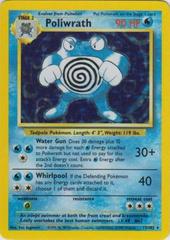
Poliwrath
13/102
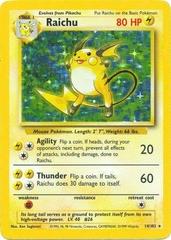
Raichu
14/102
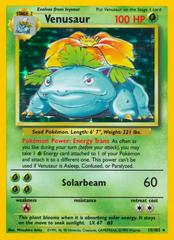
Venusaur
15/102
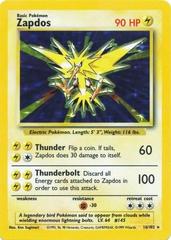
Zapdos
16/102
Card images are provided for identification via our pricing partner. Pokémon and card artwork are trademarks of their respective owners; Card Buyers is not affiliated with or endorsed by Nintendo, The Pokémon Company, or Wizards of the Coast.
The full 102-card Base Set checklist
The set contains 69 Pokémon, 26 Trainer cards, and 6 Energy cards — 16 holographic rares, 16 non-holo rares, 32 uncommons, 32 commons, and 6 basic Energy. Here is every card in number order.
| # | Card | Type | Rarity |
|---|---|---|---|
| 1/102 | Alakazam | Pokémon | Holo Rare |
| 2/102 | Blastoise | Pokémon | Holo Rare |
| 3/102 | Chansey | Pokémon | Holo Rare |
| 4/102 | Charizard | Pokémon | Holo Rare |
| 5/102 | Clefairy | Pokémon | Holo Rare |
| 6/102 | Gyarados | Pokémon | Holo Rare |
| 7/102 | Hitmonchan | Pokémon | Holo Rare |
| 8/102 | Machamp | Pokémon | Holo Rare |
| 9/102 | Magneton | Pokémon | Holo Rare |
| 10/102 | Mewtwo | Pokémon | Holo Rare |
| 11/102 | Nidoking | Pokémon | Holo Rare |
| 12/102 | Ninetales | Pokémon | Holo Rare |
| 13/102 | Poliwrath | Pokémon | Holo Rare |
| 14/102 | Raichu | Pokémon | Holo Rare |
| 15/102 | Venusaur | Pokémon | Holo Rare |
| 16/102 | Zapdos | Pokémon | Holo Rare |
| 17/102 | Beedrill | Pokémon | Rare |
| 18/102 | Dragonair | Pokémon | Rare |
| 19/102 | Dugtrio | Pokémon | Rare |
| 20/102 | Electabuzz | Pokémon | Rare |
| 21/102 | Electrode | Pokémon | Rare |
| 22/102 | Pidgeotto | Pokémon | Rare |
| 23/102 | Arcanine | Pokémon | Uncommon |
| 24/102 | Charmeleon | Pokémon | Uncommon |
| 25/102 | Dewgong | Pokémon | Uncommon |
| 26/102 | Dratini | Pokémon | Uncommon |
| 27/102 | Farfetch'd | Pokémon | Uncommon |
| 28/102 | Growlithe | Pokémon | Uncommon |
| 29/102 | Haunter | Pokémon | Uncommon |
| 30/102 | Ivysaur | Pokémon | Uncommon |
| 31/102 | Jynx | Pokémon | Uncommon |
| 32/102 | Kadabra | Pokémon | Uncommon |
| 33/102 | Kakuna | Pokémon | Uncommon |
| 34/102 | Machoke | Pokémon | Uncommon |
| 35/102 | Magikarp | Pokémon | Uncommon |
| 36/102 | Magmar | Pokémon | Uncommon |
| 37/102 | Nidorino | Pokémon | Uncommon |
| 38/102 | Poliwhirl | Pokémon | Uncommon |
| 39/102 | Porygon | Pokémon | Uncommon |
| 40/102 | Raticate | Pokémon | Uncommon |
| 41/102 | Seel | Pokémon | Uncommon |
| 42/102 | Wartortle | Pokémon | Uncommon |
| 43/102 | Abra | Pokémon | Common |
| 44/102 | Bulbasaur | Pokémon | Common |
| 45/102 | Caterpie | Pokémon | Common |
| 46/102 | Charmander | Pokémon | Common |
| 47/102 | Diglett | Pokémon | Common |
| 48/102 | Doduo | Pokémon | Common |
| 49/102 | Drowzee | Pokémon | Common |
| 50/102 | Gastly | Pokémon | Common |
| 51/102 | Koffing | Pokémon | Common |
| 52/102 | Machop | Pokémon | Common |
| 53/102 | Magnemite | Pokémon | Common |
| 54/102 | Metapod | Pokémon | Common |
| 55/102 | Nidoran♂ | Pokémon | Common |
| 56/102 | Onix | Pokémon | Common |
| 57/102 | Pidgey | Pokémon | Common |
| 58/102 | Pikachu | Pokémon | Common |
| 59/102 | Poliwag | Pokémon | Common |
| 60/102 | Ponyta | Pokémon | Common |
| 61/102 | Rattata | Pokémon | Common |
| 62/102 | Sandshrew | Pokémon | Common |
| 63/102 | Squirtle | Pokémon | Common |
| 64/102 | Starmie | Pokémon | Common |
| 65/102 | Staryu | Pokémon | Common |
| 66/102 | Tangela | Pokémon | Common |
| 67/102 | Voltorb | Pokémon | Common |
| 68/102 | Vulpix | Pokémon | Common |
| 69/102 | Weedle | Pokémon | Common |
| 70/102 | Clefairy Doll | Trainer | Rare |
| 71/102 | Computer Search | Trainer | Rare |
| 72/102 | Devolution Spray | Trainer | Rare |
| 73/102 | Imposter Professor Oak | Trainer | Rare |
| 74/102 | Itemfinder | Trainer | Rare |
| 75/102 | Lass | Trainer | Rare |
| 76/102 | Pokémon Breeder | Trainer | Rare |
| 77/102 | Pokémon Trader | Trainer | Rare |
| 78/102 | Scoop Up | Trainer | Rare |
| 79/102 | Super Energy Removal | Trainer | Rare |
| 80/102 | Defender | Trainer | Uncommon |
| 81/102 | Energy Retrieval | Trainer | Uncommon |
| 82/102 | Full Heal | Trainer | Uncommon |
| 83/102 | Maintenance | Trainer | Uncommon |
| 84/102 | Plus Power | Trainer | Uncommon |
| 85/102 | Pokémon Center | Trainer | Uncommon |
| 86/102 | Pokémon Flute | Trainer | Uncommon |
| 87/102 | Professor Oak | Trainer | Uncommon |
| 88/102 | Pokédex | Trainer | Uncommon |
| 89/102 | Revive | Trainer | Uncommon |
| 90/102 | Super Potion | Trainer | Uncommon |
| 91/102 | Bill | Trainer | Common |
| 92/102 | Energy Removal | Trainer | Common |
| 93/102 | Gust of Wind | Trainer | Common |
| 94/102 | Potion | Trainer | Common |
| 95/102 | Switch | Trainer | Common |
| 96/102 | Double Colorless Energy | Energy | Uncommon |
| 97/102 | Fighting Energy | Energy | Energy |
| 98/102 | Fire Energy | Energy | Energy |
| 99/102 | Grass Energy | Energy | Energy |
| 100/102 | Lightning Energy | Energy | Energy |
| 101/102 | Psychic Energy | Energy | Energy |
| 102/102 | Water Energy | Energy | Energy |
What languages was Base Set printed in?
Base Set was released in ten languages. From a collector's point of view, Korean is the rarest to find, while English and Japanese are the most widely collected. Note that 1st Edition exists in every language except Japanese, and No Rarity cards are Japanese-only.
English
Most widely collected
Japanese
Original release; No Rarity first print
French
European release
German
European release
Italian
European release
Spanish
Has 1999 & 1999-2000 copyright variants
Portuguese
Notable Wartortle evolution-box error
Dutch
European release
Chinese
Scarcer print
Korean
Rarest language to find
The cards that carry the value
In almost every Base Set collection, the 16 holos drive the value — and one card rules them all. If you have any of these, they are worth appraising before you sell.
Charizard
4/102The crown jewel. 1st Edition Shadowless copies are five figures graded.
Blastoise
2/102Iconic Water starter holo, strong in every variant.
Venusaur
15/102Completes the starter trio; heavily collected.
Mewtwo
10/102Fan-favorite Psychic holo with lasting demand.
Chansey
3/102Underrated holo that grades beautifully.
Alakazam
1/102The #1 card in the set — a display favorite.
Every Base Set variant, explained
Base Set has more variants than any set Pokémon has released. These occurred across multiple languages and print runs. Here is what each one means.
No Rarity Symbol (Japanese)
1st Edition
Shadowless
Unlimited
1999-2000
Trainer Deck A & B
Shadowless vs Unlimited: the 5 tells
This is the single most useful skill for a Base Set collector. Here is exactly what separates the earlier, more valuable Shadowless cards from common Unlimited copies.
| Feature | Shadowless | Unlimited |
|---|---|---|
| Drop shadow (right of art) | Absent — flat border | Present — shadowed border |
| Color saturation | Brighter, more vibrant | Slightly muted |
| HP text weight | Thinner | Bolder |
| Card image framing | Zoomed in | Zoomed out |
| Copyright date | ©1995, 96, 98, 99 | ©1995, 96, 98 |
The 8 English print runs
- 11st Edition (first print run, stamped)
- 2Shadowless (first print run, unstamped)
- 3Unlimited — print runs 2 through 7
- 41999-2000 (the eighth and final English print run)
1st Edition stamp variants
Even the 1st Edition stamp itself has collectible variations, caused by inconsistencies in the stamping process:
- Thick vs Thin: The thickness of the "1" inside the circle, driven by stamping pressure. Thin stamps are common on holos; thick stamps are rarer.
- Gray stamps: Ink transferring between card sheets during production leaves a faint gray stamp. Uncommon and sought after.
- Off-aligned: The stamp misses its intended placement, giving a slight "3D" look — most visible on non-holo cards.
Famous errors & misprints
As the first set, Base Set is full of errors — and the ones limited to a handful of prints can carry big premiums. These are the best-known:
Limited errors (only some copies)
These occur on a subset of prints, which is exactly what makes them valuable to collectors.
No Stage Blastoise
A printing error omitted the word "Stage" from Blastoise's text. Found in Unlimited booster packs.
No Damage Ninetales
Some Shadowless Ninetales are missing the damage value on Fire Blast. Distributed in Bushfire theme decks.
Ghost Stamp Pikachu
Certain Shadowless Pikachu show a faint outline where the 1st Edition stamp would sit. Found in Zap! theme decks.
Evolution Box Wartortle
Unlimited English Wartortle with a misprinted evolution box showing Wartortle instead of Squirtle.
Red Cheeks Pikachu
Early 1st Edition and Shadowless Pikachu were printed with red cheeks instead of the later yellow.
Margin Spacing Water Energy
Many Unlimited Water Energy cards were printed missing the space above the card name. Pulled from booster packs.
Galaxy Star Machamp
A cosmic/galaxy foil Machamp from the 2-Player CD-ROM Starter Set — an intentional foil variant, not an error.
Errors on every copy of a variant
Unlike the errors above, these appear on every card of the listed variant — so they help with identification rather than commanding a premium.
| Card | Variant | What's wrong |
|---|---|---|
| Charizard | No Rarity (JP) | Height/weight box misprinted — wrong species text, 1.5 m / 70.5 kg. |
| Raichu | No Rarity (JP) | Wrong Pokédex number: 25 instead of 26. |
| Venusaur | No Rarity (JP) | Wrong Pokédex number: 68 instead of 3. |
| Gastly | No Rarity (JP) | Destiny Bond attack text reads みちずれ instead of みちづれ. |
| Gyarados | Unlimited / 1999-2000 | Set number 6/102 spaced too far to the left. |
| Kakuna | 1st Ed & Shadowless | Weight is mislabeled as "length." |
| Bulbasaur | 1st Ed & Shadowless | Weight is mislabeled as "length." |
| Caterpie | 1st Ed & Shadowless | HP printed as "HP 40" instead of "40 HP." |
| Metapod | 1st Ed & Shadowless | HP printed as "HP 70" instead of "70 HP." |
| Vulpix | 1st Ed / Shadowless / Unlimited | HP printed as "HP 50" instead of "50 HP." |
| Sandshrew | 1st Ed & Shadowless | Reads "this attack does nothing" instead of "that attack does nothing." |
| Voltorb | 1st Ed & Shadowless | Reads "Monster Ball" instead of the localized "Poké Ball." |
| Switch | 1st Ed & Shadowless | Reads "1 of your own Bench Pokémon" instead of "1 of your Bench Pokémon." |
| Imposter Professor Oak | 1st Ed & Shadowless | Printed "Impostor" (with a T) — later prints corrected it to "Imposter." |
| Nidoran♂ | All but CN/JP/KR | A space appears between the "n" and the ♂ symbol. |
Other special variants
Beyond the main print variants, Base Set has a handful of special cards — mostly Pikachu promos and one unusual Machamp — that serious collectors specifically hunt.
Galaxy Star Machamp
From the 2-Player CD-ROM Starter Set, with a cosmic/galaxy foil instead of the usual starry holo. Intentional, not an error.
Red Cheeks Pikachu
Early 1st Edition and Shadowless Pikachu with red cheeks instead of the later yellow. Booster-pack only, harder to find.
Red Cheeks E3 Pikachu
A Shadowless red-cheeks Pikachu with an "E3" stamp, handed out at the 1999 Electronic Entertainment Expo — very rare.
Yellow Cheeks E3 Pikachu
Unlimited yellow-cheeks Pikachu that keeps the "E3" stamp, distributed via Nintendo Power in September 1999.
PokéTour Pikachu
Given out at the 1999 Australian PokéTour, with a unique stamp in the top-right of the artwork.
CD Promo Shadowless Pikachu
Nearly identical to a normal Shadowless Pikachu but on smoother Media Factory card stock, packed with the Pokémon Song Best Collection CD.
Sealed Base Set product
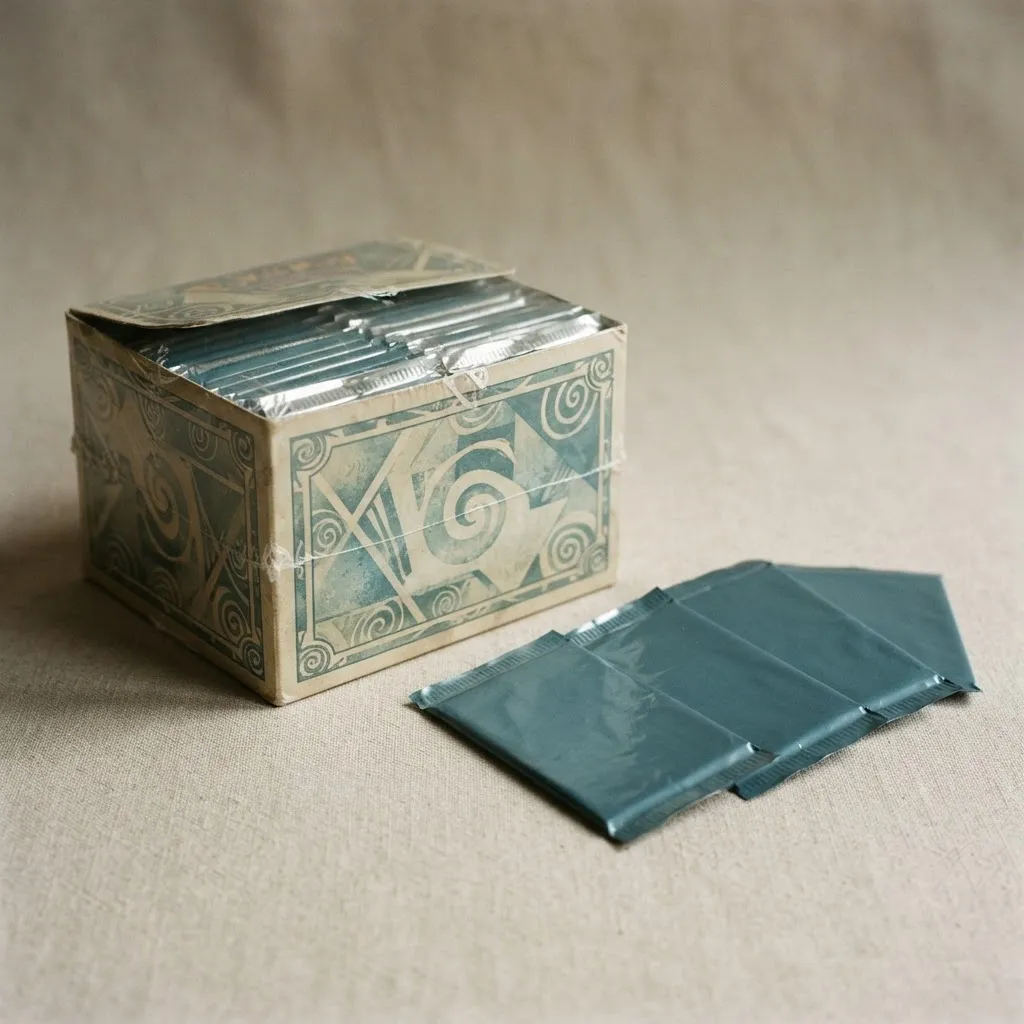
Base Set shipped in booster boxes, booster packs, blister packs, theme decks, gift boxes, and starter decks. Sealed product is where the biggest money sits today — and where the most fakes and resealed items appear, so it pays to know the details.
- Booster boxes: Held 36 packs (12 with a holo). Variations include a 1st Edition marker, square/curved/no Wizards logo, "Green Wing" vs "Blue Wing" Charizard art, and USA/UK/Australia manufacturing.
- Booster packs: Three artworks (Charizard, Blastoise, Venusaur) across 10 pack types = 30 variations. Logo placement, 1st Edition stamp, seal type, and copyright date all matter.
- Theme decks & blisters: Theme decks (Zap!, Bushfire, and more) and blister packs, which sell at a premium partly because they resist "pack weighing."
Because authenticating vintage sealed product is tricky, always have it evaluated by a specialist before buying or selling.
The five theme decks
English Base Set had five preconstructed theme decks, each built around two types and containing one guaranteed holographic rare. Theme decks can hold Shadowless, Unlimited, or 1999-2000 cards — and are a known source of a few error cards.
| Deck | Holo | Types | Notes |
|---|---|---|---|
| 2-Player Starter Set | Machamp (exclusive) | Fire / Fighting | The only way to get the holo Machamp. Two 30-card decks plus rulebook, coin & counters. |
| Blackout | Hitmonchan | Fighting / Water | Includes a rulebook, Chansey coin, damage counters and checklist. |
| Brushfire | Ninetales | Fire / Grass | Source of some No Damage Ninetales error cards. |
| Overgrowth | Gyarados | Grass / Water | Grass/Water starter-heavy build. |
| Zap! | Mewtwo | Lightning / Psychic | Source of some Ghost Stamp Pikachu error cards. |
Trainer Decks A & B
Trainer Decks were league-only decks, marked "Not For Resale," used to teach the game. Their cards are identifiable by a red border with "Trainer Deck A" or "Trainer Deck B" printed in red on the back. Both decks contained a holo printed without foil, which makes those two cards especially distinctive.
Trainer Deck A
Brock's Deck · Pewter City
The commonly used league deck, so surviving cards often show wear. Its Machamp was printed without holo foil.
Trainer Deck B
Misty's Deck · Cerulean City
Far scarcer and usually cleaner. Its Blastoise was printed without holo foil. Marked "Not For Resale."
Japanese Base Set
The Japanese release came first, in October 1996, and has its own sealed products and print quirks — including the coveted No Rarity first print. Here is what to know.
Booster Packs
10 cards per pack (1 rare, 3 uncommon, 5 common). Three versions exist: short ¥291, long ¥291, and long ¥300 (after Japan's April 1997 tax increase).
Starter Decks
60 cards plus a guidebook and Chansey coin. Four versions differ by postal code (104-01 vs 104-0061) and rulebook edition; the earliest can rarely contain No Rarity cards.
1996 Gold Gift Box
Released December 12th, 1996 and extremely rare. Contains the first-print how-to-play magazine, a playmat, counters, and two early 104-01 starter decks — the boxes most likely to hold No Rarity cards.
What is your Base Set actually worth?
Value comes down to four things: variant(1st Edition > Shadowless > Unlimited > 1999-2000), card (holos, especially Charizard, lead the way), condition, and whether it is graded. A Gem Mint 1st Edition holo can be worth many multiples of a played Unlimited copy of the same card.
Online price guides show asking prices, not real sale values, and they can't judge your exact condition or variant. The fastest way to a real number is a free appraisal from buyers who value these cards every day.